
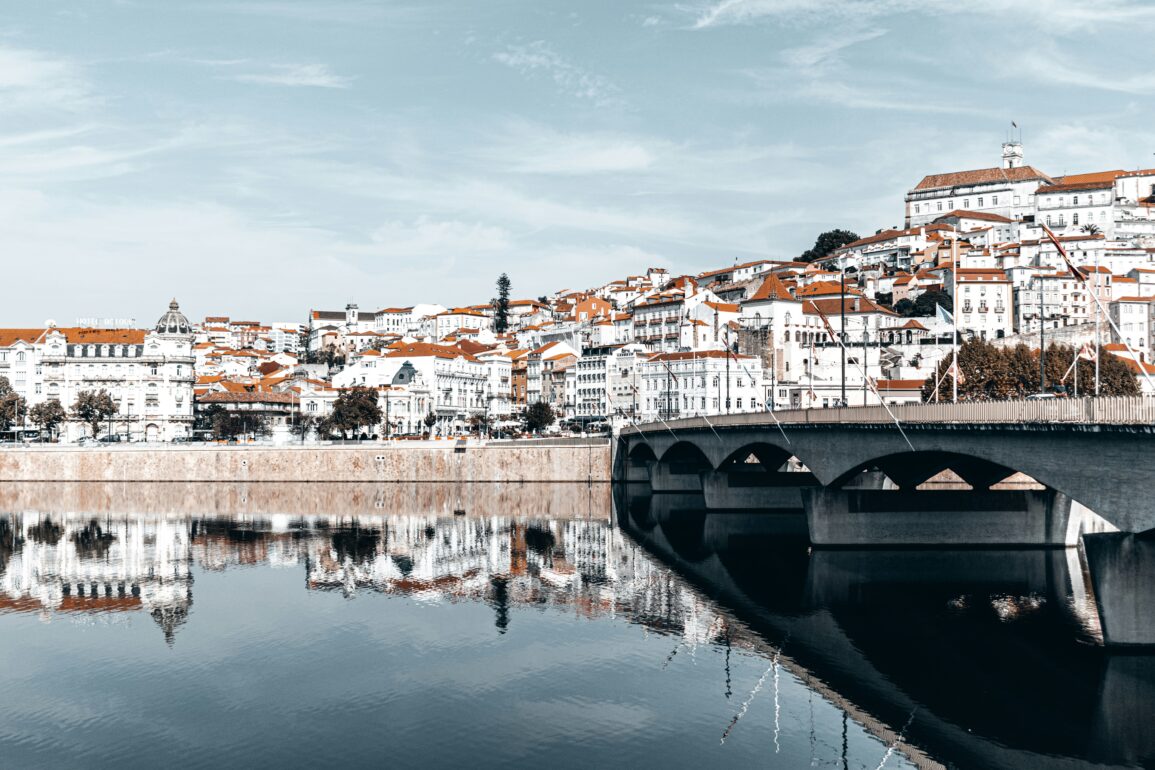

Geographically, Coimbra sits almost bang in the middle of the country, halfway between Lisbon and Porto, on the banks of the Mondego, the longest river entirely in Portugal. This guide will is directed at anyone with Coimbra travel plans, or to those aiming to understand the country’s cultural and historical legacy.
Politically and historically, though, it’s much closer to the origin story. Long before Lisbon was capital, Coimbra was the centre of power of the new Portuguese kingdom. D. Afonso Henriques, the first Portuguese king, ruled from here in the 12th century, and his tomb is still in the Monastery of Santa Cruz, right in the historic centre. If Lisbon tells the story of empire and the sea, Coimbra tells the story of how Portugal became a country at all:
- It remained the capital of the kingdom until 1255, when the court moved to Lisbon.
- It was the birthplace of several kings of the portuguese first royal dynasty.
- It’s here where the first national pantheon is located, the burial ground for all those first dinasty kings.
- It’s home to the country’s first (and still most symbolic) university and also one of the oldest in the world. It would shape not just Portugal but the whole Lusophone (portuguese speaking) world.
All of this is layered over an even older history: the Roman town of Aeminium which received the inhabitants of the nearby conquered and sacked Roman town named Conimbriga, later a Moorish trading city called Kulūmriyya, then a frontier Christian stronghold, until today’s modern denomination.
What are the main differences between Lisbon and Coimbra?
Where Lisbon’s history sprawls over multiple districts, in Coimbra you feel it converge: hills stacked with medieval walls, monasteries, Roman cryptoporticos and baroque palaces, all within a 15–20 minute walking radius.
Coimbra and Lisbon share a country but project entirely different energies. Lisbon is expansive, global and tourist-driven, while Coimbra is intimate and intellectually powered, shaped by students, research centres and the academic calendar. Where Lisbon feels international and polished, Coimbra remains deeply local, authentic and rhythmically tied to university life.
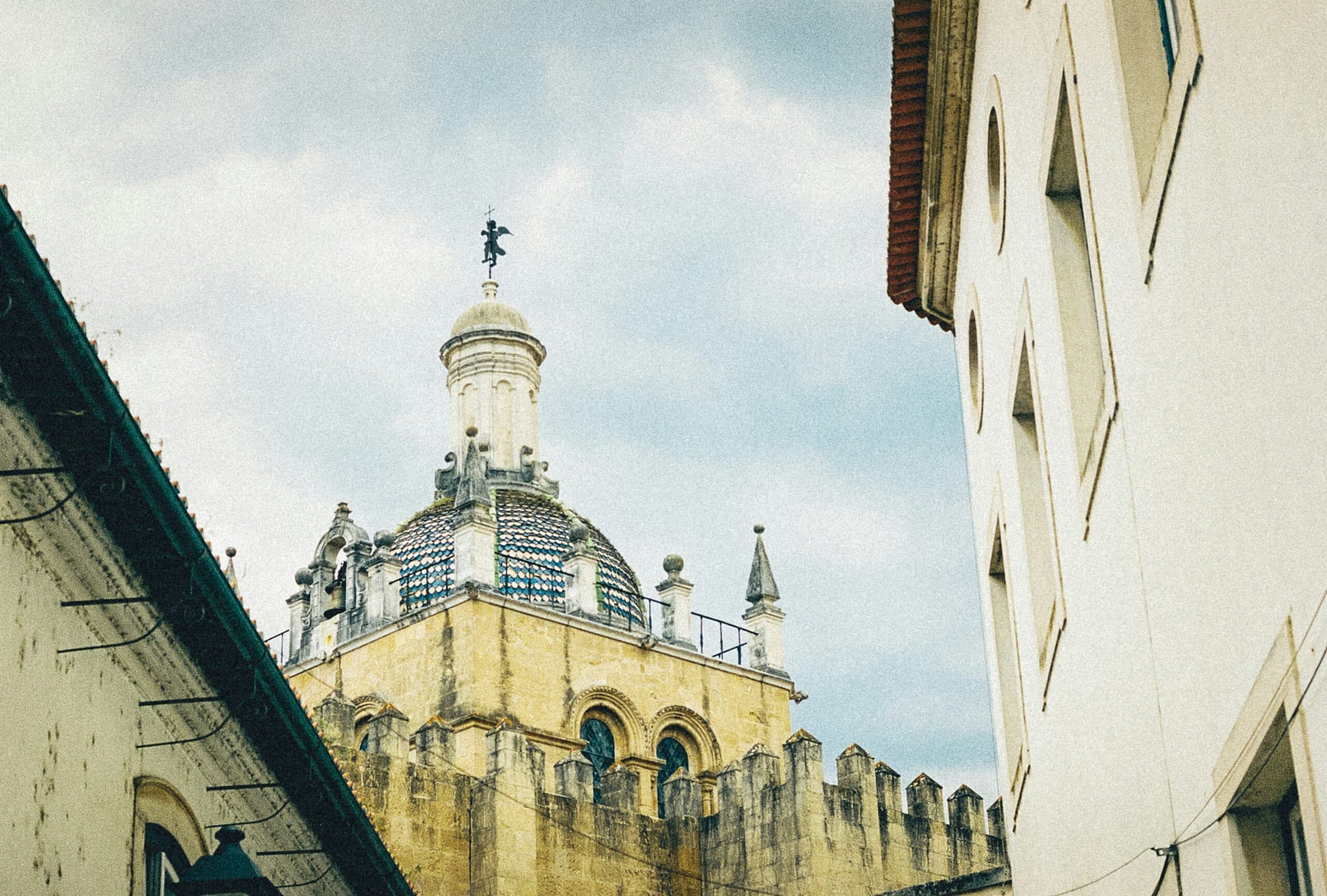 Like in every portuguese city, there’s a strong feeling of past culture and arquitecture. Photo: Joana Abreu via Unsplash
The City of Students, and Why That Matters Politically
Every Portuguese person knows Coimbra as the cidade dos estudantes (city of students) thanks to its university, the Universidade de Coimbra, founded in 1290 and permanently rooted here since 1537. This institution has been a political and cultural engine for centuries, shaping the minds that would later shape the country. For much of Portuguese history, anyone destined to become a judge, minister, diplomat or senior civil servant almost inevitably passed through Coimbra. Its classrooms, libraries and cafés acted as a national training ground where ideas about law, governance and culture were debated.
The University also played a defining role in standardising Portuguese and nurturing its literature, a legacy recognised in 2013 when UNESCO inscribed “University of Coimbra – Alta and Sofia” as World Heritage. It is called Alta e Sofia because the university grew between the hilltop Alta and Rua da Sofia (Sofia Street), named from the Greek Sophía for “wisdom.” UNESCO highlights this pairing as rare evidence of a city physically and being historically shaped around its university’s academic, political and architectural development. And while it helped consolidate tradition, it was equally a cradle of revolt: during the Estado Novo dictatorship, Coimbra’s students became central voices of dissent, organising protests and composing protest songs that would later soundtrack Portugal’s road to democracy.
That political pulse still beats through the city today. The praxe rituals, (student freshman initiation rites), the semi-communal and often ideological student repúblicas (similar to student fraternities), and the grand annual student festival, the Queima das Fitas, all echo centuries of hierarchy, resistance and reinvention. If Lisbon is the stage where politics is broadcast, Coimbra is the workshop where generations learned to question authority. Here they learned how to organise movements and write the manifestos that would reshape the nation.
The Emotional Core: Pedro & Inês, Fado and Saudade
Every city has a story that explains its mood, and Coimbra’s emotional identity is inseparable from saudade: that uniquely Portuguese blend of longing, melancholy and bittersweetness. Here, saudade isn’t just a feeling; it’s a mythology, woven into the landscape and sung into the night.
Nowhere is this more evident than in the tragic love story of Pedro and Inês. The doomed affair between the future king D. Pedro and his Galician lover Inês de Castro, later assassinated on account of D. Pedro’s father’s royal orders. This legendary love story has become part of Coimbra’s emotional architecture. The story clings to the lush gardens of Quinta das Lágrimas, where the lovers are said to have met in secret, and where visitors today still stop by the Fonte dos Amores (fountain of love) and Fonte das Lágrimas (Fountain of tears). Legend claims that the reddish stains on the rocks mark the blood of Inês, a dramatic embellishment perhaps, but one so deeply embedded in local memory that separating fact from myth feels unnecessary. The truth is simple: the city has adopted their heartbreak as its own.
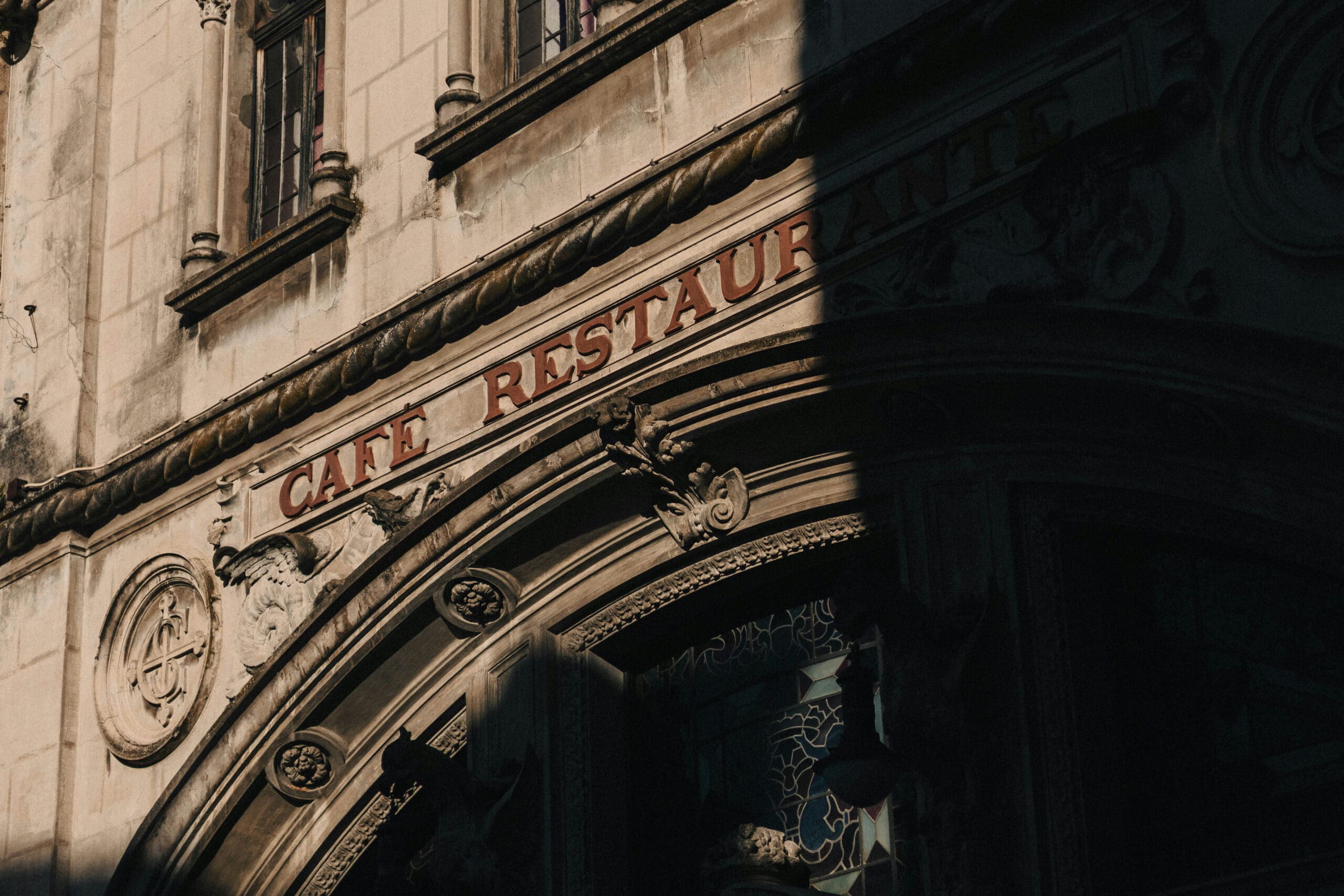 Cafe Santa Cruz facade. Photo: Vik Molina via Unsplash
Fado, the portuguese most traditional form of music, with a Coimbra twist
That same tenderness runs through Fado de Coimbra, a musical tradition that diverges sharply from Lisbon’s smokier, tavern-born fado. In Coimbra, the genre lives in a different register. It is traditionally sung only by male students or former students, dressed in black academic capes that rustle like shadows under the lamplight. The Portuguese guitar is tuned differently here, producing a darker, more resonant tone that perfectly matches themes of love, the city, the university, and the soft ache of exile after graduation. Performances often take place in chapels, courtyards and candlelit salons, and audiences are asked not to applaud between songs, preserving an atmosphere that feels closer to ritual than entertainment.
Even the city’s viewpoints carry the weight of sentiment. At the Penedo da Saudade, stone plaques engraved with student verses cluster along the pathways, transforming the overlook into an open-air anthology of emotion. Generations have come here to etch their poems into stone, declarations of love, nostalgia for their student years, farewells to the city they’re about to leave behind. It is both a lookout and a memory bank, where Coimbra’s long romance with poetry, longing and youth is made physical. Coimbra wears its feelings openly, almost ceremonially. If Lisbon performs its stories, Coimbra confesses them.
Geography with Layers: A Practical Itinerary Through Coimbra for 3D2N stay
Start in Baixa, Coimbra’s historic lower town. Begin at Largo da Portagem, the main entry square, then follow Rua Ferreira Borges, the city’s busiest pedestrian street filled with traditional shops and cafés. Continue to Praça 8 de Maio, home to the Mosteiro de Santa Cruz, where Portugal’s first two kings, D. Afonso Henriques and D. Sancho I, are buried. Just beside it, Café Santa Cruz, operating since 1923 in a former chapel, is a convenient stop before moving uphill.
From Baixa, enter the medieval upper town via the Porta de Almedina, one of the old city gateways. Climb the Quebra-Costas street to reach the Sé Velha, a 12th-century Romanesque cathedral that survived largely intact. Continue upward into the Alta Universitária, where the University of Coimbra occupies the former royal palace. Key sites include the Paço das Escolas courtyard, the Biblioteca Joanina (an 18th-century baroque library with over 50,000 volumes), the Sala dos Capelos, and the Torre da Universidade, which overlooks the river. The nearby Jardim Botânico, founded in 1772, is one of the oldest botanical gardens in Europe and an easy detour.
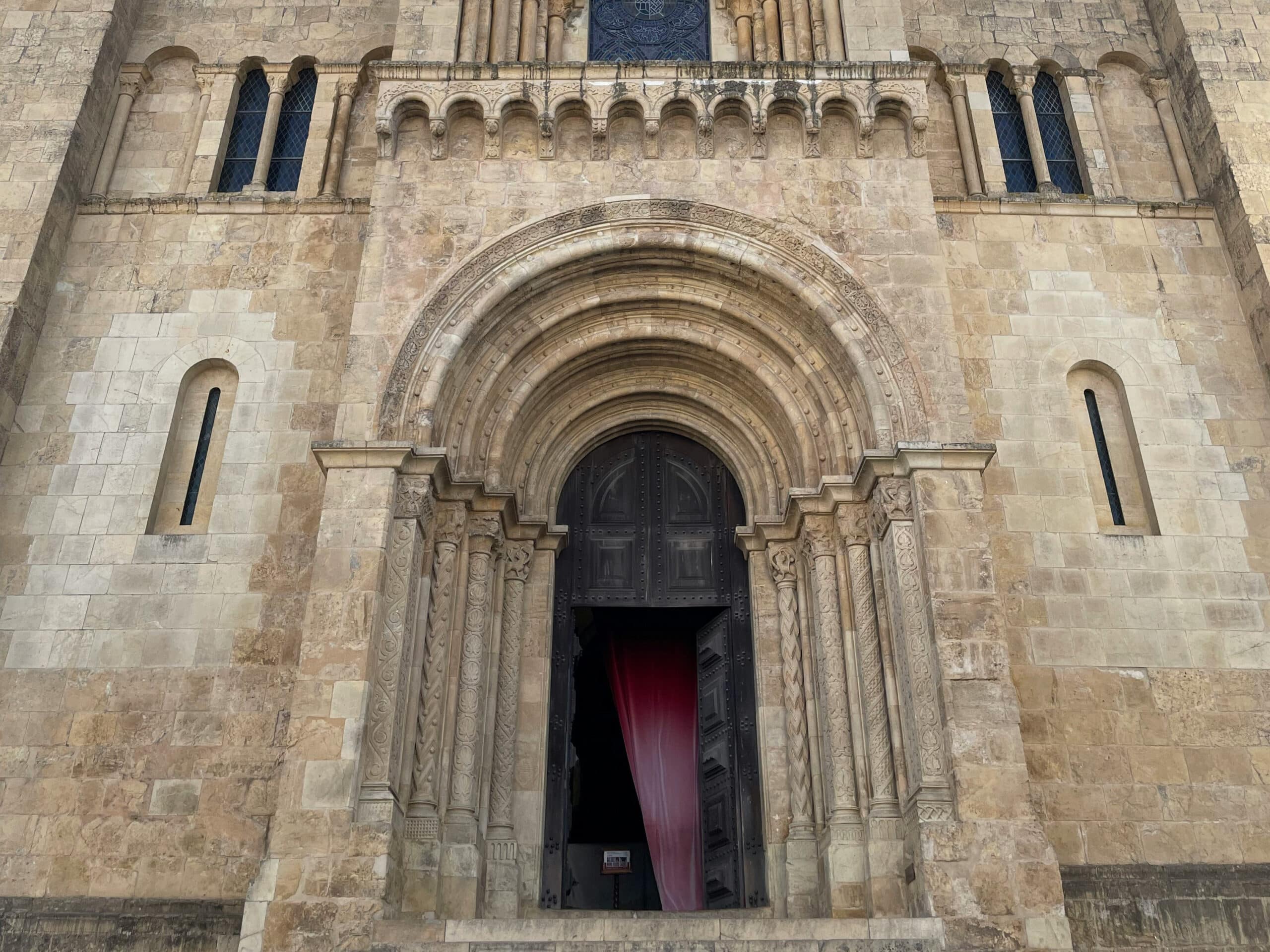 Coimbra’s Cathedral – Sé Velha – entrance. Photo: Michael Martinelli via unsplash
Crossing the Mondego to discover the other side of town
Cross to the south bank of the Mondego via the Ponte Pedro e Inês, a pedestrian bridge known for its coloured glass panels. Just a few minutes’ walk from the bridge lies the Quinta das Lágrimas, a historic estate tied to the legend of the legendary couple. Its gardens contain the Fonte dos Amores and the Fonte das Lágrimas, sites associated with the 14th-century romance that has become part of Coimbra’s cultural identity.
From here, continue to the Mosteiro de Santa Clara-a-Velha, a 14th-century monastery partly submerged for centuries due to river flooding; today it has an excellent interpretation centre explaining its excavation and conservation. A short uphill walk leads to Santa Clara-a-Nova, built in the 17th century to replace the flooded convent and housing the silver-and-crystal tomb of Rainha Santa Isabel, an extremelly important historical personality, both politically and religiously, and Coimbra’s patron saint.
Within the same district, Portugal dos Pequenitos offers detailed miniature replicas of Portuguese monuments and traditional houses, particularly entertaining for families with young children or visitors interested in Portuguese traditional architecture.
End the itinerary along the Parque Verde do Mondego, a large riverside park with walking paths, cycle routes, river cafés and venues frequently used for festivals and outdoor events.
Compared to Lisbon’s broad Tejo, the Mondego is narrower and more central to daily life, making it easy to navigate both banks in a single visit while accessing many of Coimbra’s most significant historical sites.
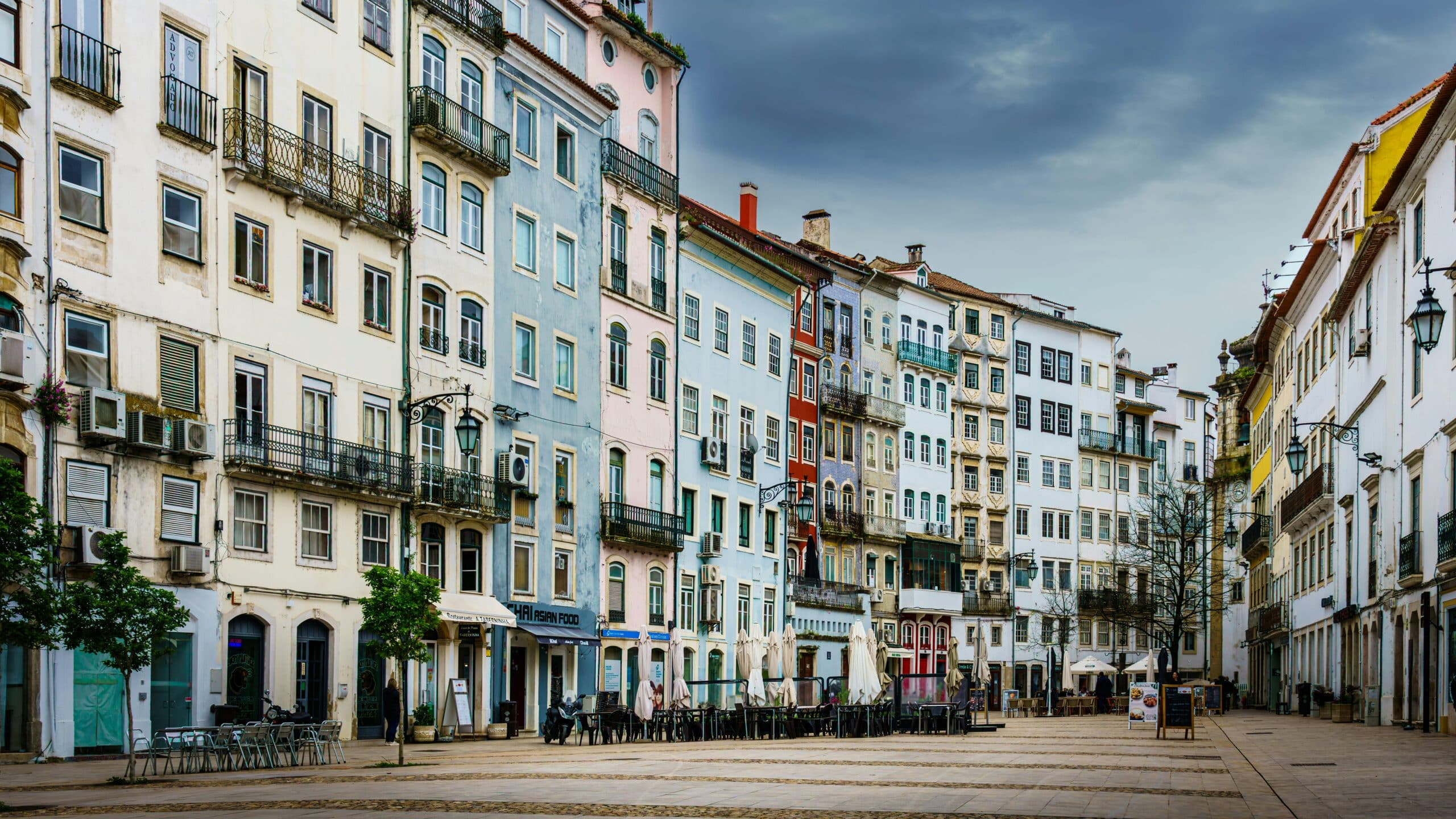 Coimbra’s Baixa looks in many ways similar to Lisbon. Photo: Marc Andre Paradis via Unsplash
Coimbra as Your Base: What the Region Opens Up for Travellers
Coimbra’s geographical location within Portugal makes it not only easy to reach but ideal as a base for exploring central Portugal. Its location on the country’s main north–south rail lines and motorways means you can step off a train or park your car and be within easy striking distance of some of Portugal’s most remarkable historical and natural sites.
As the region’s administrative and service capital, Coimbra anchors a diverse surrounding landscape: river valleys, mountain ranges, dense forests, Atlantic beaches and archaeological sites that tell chapters of Portuguese history long before the country existed. Travelling in any direction reveals a different layer.
Just minutes south of the city lies Conímbriga, one of the best-preserved Roman settlements in Portugal. Its mosaics, baths and villa foundations offer one of the clearest windows into the Roman presence in the Iberian Peninsula. To the north-east, the Mata do Bussaco pulls you into an entirely different world: a walled forest planted by Carmelite monks, filled with rare species and crowned by the neo-Manueline (portuguese version of Baroque) Bussaco Palace that now operates as a hotel.
Head a little further into the hills and you reach the Serra da Lousã, known for its schist villages, waterfalls and well-marked hiking trails, one of the most atmospheric mountain regions in the country. Or go west to the coast and you’ll arrive at Figueira da Foz, a Portuguese seaside town spread along wide Atlantic beaches at the mouth of the Mondego.
What Lisbon tells you about Portugal, its past, its maritime identity, its shine, Coimbra tells inwardly. It’s a city that represents it through its students, traditions, research institutions and long collective memory. But as a traveller, its greatest advantage may be this: from Coimbra, the heart of Portugal is quite literally all around you.